The country and its armies
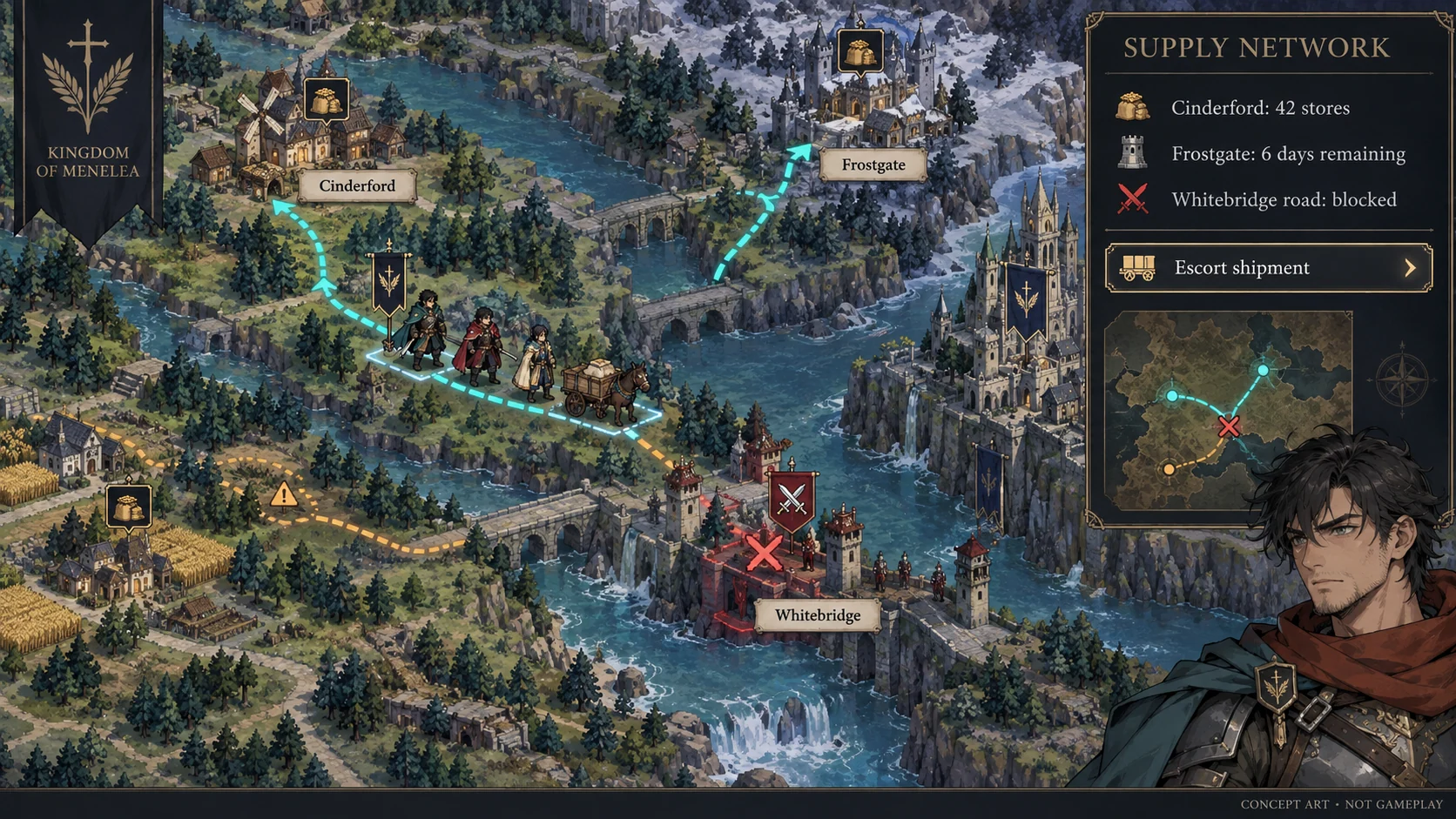
Working design. New events, appearances, mechanics, and political details remain proposals. See canon ledger.
Scale
Use 12 provinces in the intended full campaign, with 3 in the first playable slice. Initially Pyrrhus commands one company and has stewardship responsibilities for one refuge. Authority expands through negotiated charters, occupations, and alliances. He need not personally annex every province to finish the story.
Illustrative provinces: Cinderford (river crossing and grain), Greyfen (wetland villages), Whitebridge (truce road), Thorn March (disputed eastern frontier), Saltmere (port and customs), Frostgate (northern pass), Bellwether (orchards), Highmere (noble estates), Emberfield (smiths), Redwater (irrigation), Saint's Rest (hospitals and archives), and the Crown Demesne (royal seat). All are new working names and their geography is deliberately unbound to the canonical atlas.
The ledger
Country resources: coin, provisions, and available manpower. Province values: food stock, public order, garrison, war damage, and allegiance. Food stock feeds provision shipments but remains physically located; a safe road matters. Present public order as 100 minus unrest, not a second independent simulation variable. War damage reduces output and creates reconstruction needs.
One provision unit is an abstract shipment, not one loaf. A local food stock is reported in the same units. Manpower is available recruits, not the whole civilian population. The simulation tracks displaced households separately for relevant events rather than pretending that all humans are interchangeable recruitment currency.
Proposed early-week economy for a connected province:
- Food produced = base yield × season factor × (1 − war damage / 100), rounded down.
- Subtract civilian demand and local garrison demand first. Allocate any export as an explicit order; never silently starve locals to refill the hero's packs.
- A 100-soldier garrison consumes 10 supply units each week in the first balance pass; Pyrrhus's traveling company consumes 1 unit per travel day, including animals, attendants, and transport losses. These ratios need simulation against actual force sizes.
- Public order changes through security, shortages, requisition, promises kept, and occupation. At unrest 60 show organized resistance; at 80 warn of a possible revolt with a response window. Neither is an instant game-over switch.
- Coin pays wages, repairs, purchases, and bribes. Manpower replaces losses and fills new detachments. Conscripting during harvest reduces next week's yield and increases unrest.
These values are test scaffolding. A spreadsheet or simulation run must validate them before treating them as tuned rules.
Orders and delegation
Each province can maintain one civil project and one military stance. Available civil projects: repair, distribute relief, collect ordinary taxes, requisition, resettle, recruit, negotiate. Military stances: defend, patrol, escort, raid, muster. Regional templates let the player set a policy once and respond to exceptions. Distant orders arrive through visible courier delays, initially one day per road segment, while trusted stewards continue standing orders.
A named officer can be assigned as steward or field commander. Their command, stewardship, diplomacy, and conviction affect outcomes. Their job gives a modest contextual advantage. They are unavailable to Pyrrhus's battle party until recalled and returned by travel. Administrative skill should not force the strongest combat unit into permanent desk duty; train lieutenants and allow a modest bench of specialist noncombat officers.
Examples: Yselle improves tax predictability and fort defenses but may prioritize contracts over popular relief. Mira reduces sickness but will resist discriminatory hospital access. Seris can negotiate passage in the marches but cannot simply order independent clans around. They tell Pyrrhus what they intend to do before it becomes a surprise betrayal.
A clock that creates choices without rushing menus
Time advances only when the player commits travel, resting, a project wait, or a mission with an explicit time cost. Reading dialogue, inspecting maps, building a character, and considering council choices are free. A tactical battle consumes its stated campaign duration once, independent of real-world playtime.
Advance the campaign one day at a time internally. Resolve dated raids on their due day; on every seventh day resolve economy, wages, project progress, and standing policies in a documented order. If a five-day trip crosses an event, pause at the last reachable decision point and explain available responses. Route preview lists every known event crossed, provisions required, and safe alternatives.
Critical incursions are normally telegraphed 3–5 days ahead. A blind border may produce shorter warning, but the interface must identify that intelligence risk. Named deadline missions state the failure outcome before departure; the player can choose a loss rather than discover a silent campaign lockout.
Battles away from Pyrrhus
Territorial forces are detachments with soldiers, readiness, equipment quality, commander, provisions, and morale. They are distinct from the six-to-eight named units on a tactical board. A tactical squad represents the decisive local action within a larger engagement; a single sprite does not ambiguously switch between one person and an entire regiment.
Remote clashes resolve through a transparent model: relative soldiers × readiness × equipment, modified by terrain, supply, command, and stance. Preview outcome bands such as "likely hold; 10–25% losses" with intelligence confidence. Store the random seed at commitment. A log explains meaningful factors after resolution. Avoid an opaque power number that lies about captives and supply losses.
The player chooses a doctrine—hold, delay, withdraw, or costly counterattack—and can dispatch reinforcements or negotiate beforehand. Pyrrhus can personally intervene only if he can arrive. Do not let him teleport into every remote battle. A future feature may let players command a lieutenant in an authored battle, but that is outside the first release scope unless playtesting demands it.
Wars between third parties can cut trade routes, send refugees, change access, or create a coalition opportunity. Each faction gets a limited operational budget per week and a coherent agenda. It must pay supplies and obey travel rules. Early story chapters constrain the simulation to preserve a learnable situation; later chapters relax those constraints, transparently marking ceasefires and mustering periods in the fiction.
Defeat without a campaign soft lock
Losing a province removes its income and recruitment, creates displaced households, and changes access. It does not silently delete a required story character or the only route to the next chapter. If Pyrrhus loses every holding, the company can operate from an allied refuge or mobile camp with stricter supply limits and recovery missions. A country devastated by neglect reaches a visibly worse political settlement even if the hero survives his personal campaign. Optional challenge settings may make national collapse a formal defeat; standard play favors recoverable setbacks and a difficult ending over an unwinnable save.
At every chapter transition, validate that the remaining faction relationships, travel graph, and required witnesses still permit at least one authored continuation. Escape routes, substitute witnesses, and prisoner exchanges are designed content, not emergency rewrites triggered by an AI narrator.
Source document: 01-game-design.md