Tactical combat
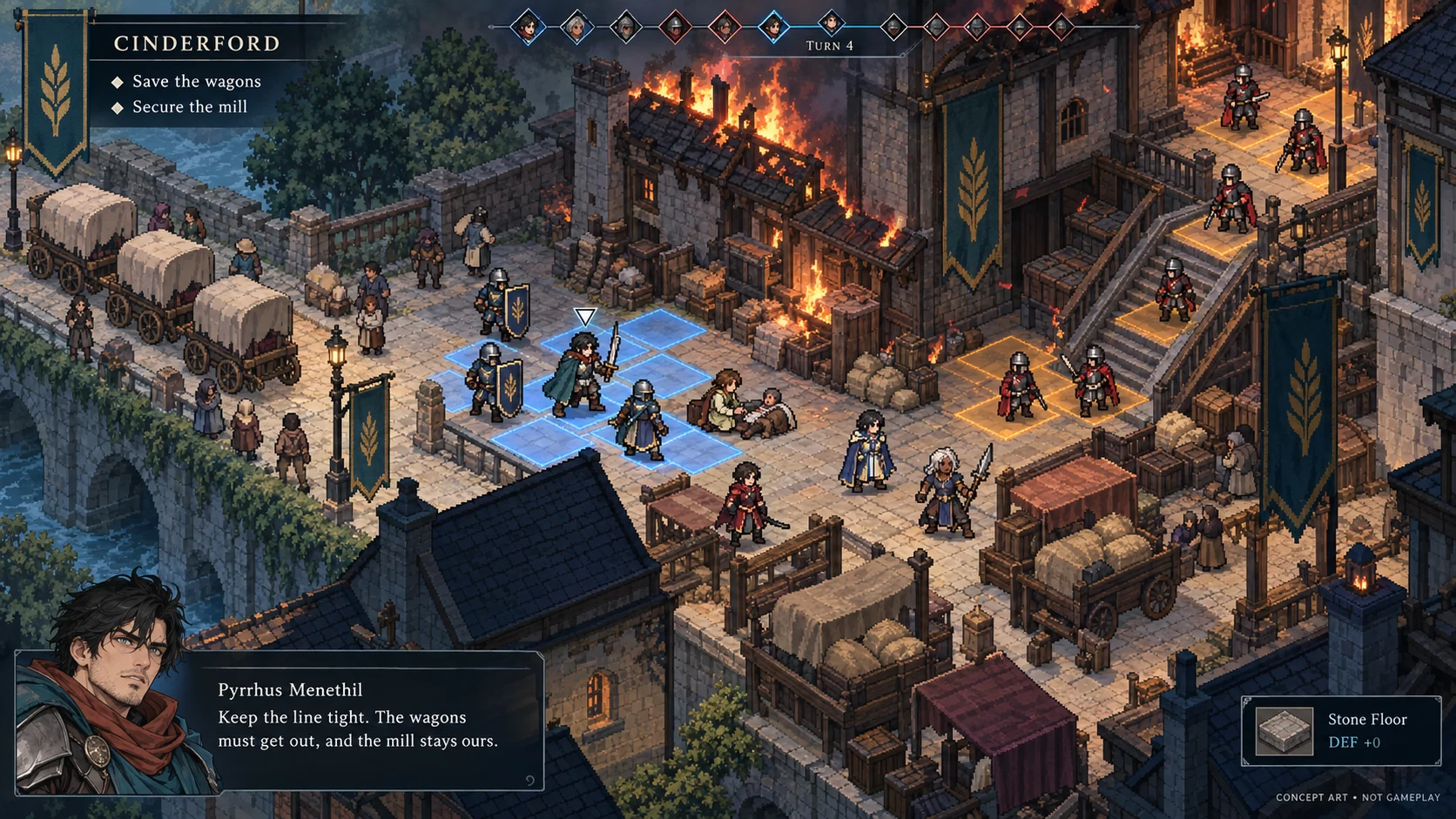
Working design. New events, appearances, mechanics, and political details remain proposals. See canon ledger.
Scope: The following describes the intended full game. See the first playable for its deliberately smaller implemented rule set.
Battle structure
Deploy six controllable units initially, rising to eight for major battles; maintain a roster of roughly 16–24. Named allies and generic recruits follow the same core rules. Story guests occupy explicitly shown guest slots. Ordinary enemies number 6–12, with reinforcements used to create pressure instead of enormous starting crowds.
Maps begin around 12 × 12 logical cells; later maps may reach 20 × 20. A cell can contain multiple distinct walkable surfaces, such as a bridge over a road. Height, stairs, cover, facing, and terrain create the puzzle. A 15–30 minute ordinary battle is the initial target. Larger climaxes must justify their duration through changing objectives.
Use an individual readiness timeline. A unit activates at 100 readiness, may move once and take one action in either order, then chooses facing. Unused movement is lost; partial move–act–move is an explicit advanced skill rather than a universal rule. Actions incur recovery, so light actions cycle faster than heavy ones. Charged abilities put their resolution on the timeline and preview whether targets can move first. A bounded speed range prevents permanent turn monopolies.
Call this meter Readiness in this game: the later tabletop site uses AP in a way that should not be silently copied into a different action economy.
Terrain and positioning
- Four logical facing directions; rear attacks gain a clearly previewed bonus. Later tactical prototype proposal: +20% HP damage from directly behind, no diagonal rear bonus, borrowing an existing setting rule with explicit adaptation.
- Height improves sightlines and some ranged attacks, but every ability specifies its climb and vertical limits. A roof is valuable because of approach geometry, not a universal damage multiplier.
- Low walls obstruct movement and reduce some ranged accuracy. Full obstacles block line of sight. Arrows and direct spells can use different trajectory tests.
- Water, mud, stairs, doors, ladders, and broken bridges have distinct movement costs or links. Fire spreads only over authored combustible regions with a visible next-step preview.
- Units can protect an exit, intercept a carrier, shove an enemy off a safe ledge, or occupy a signal point. Fatal falls are rare, marked, and accounted for in the attack forecast.
- Clear allied passage rules: move through allies, never end inside them. Enemy zones of control stop ordinary movement; mobility jobs have explicit exceptions.
Forecast and randomness
Before confirmation show hit probability, HP damage, guard damage, status chance, collateral effects, retaliation, and affected units. Prototype HP damage is a simple attack-minus-defense calculation, minimum one on a successful damaging hit. Defense is separated into physical and magical resistance. Armor also has a finite Guard meter: Break skills damage Guard, and Guard at zero exposes the target for a short window. Avoid making armor simultaneously an endlessly regenerating health bar and a hidden multiplicative reduction.
The existing tabletop rules use an effectiveness roll after calculating damage. For this digital game, test a simpler hit model against that roll; select one before balancing content. Do not stack both sources of variance by default. Use seeded randomness, honest percentages, and bounded outcomes. The displayed forecast must use the same rule functions as resolution.
Morale, wounds, and recovery
Company cohesion is the campaign measure of trust in leadership. Unit resolve is a local battle resource influenced by nearby allies, casualties, personal obligations, and rally abilities. Province unrest belongs to civilians and is separate. The player should never have to infer which of three identically named morale bars a decision changes.
Low resolve first weakens reactions and resistance to intimidation. At zero, ordinary enemies can surrender or withdraw; the player's units do not randomly discard a turn. A player can choose an emergency retreat, or spend a command resource to hold a vulnerable formation together. Visible traits can give a companion a personal crisis, but it is a narrative event with warning rather than an unexplained AI override.
At zero HP, a unit becomes downed with a three-activation rescue window shown on the timeline. Stabilization, carrying, or winning with control of the body avoids death. A recovered unit gains a wound requiring rest, treatment, or a temporary assignment away from combat. On standard difficulty, an unrecovered unit is captured or suffers a severe injury where the fiction supports it; explicit lethal conditions remain possible and are signposted. On optional Iron Chronicle difficulty, an expired rescue window can cause permanent death. Pyrrhus's death means battle failure, not an alternate campaign without the protagonist.
Other mandatory story characters receive consistent capture/injury outcomes on standard mode; optional permadeath requires fallback scenes authored before that mode ships. No Academy recall beacon technology is assumed for this historical period.
Source document: 01-game-design.md