A prince on the road
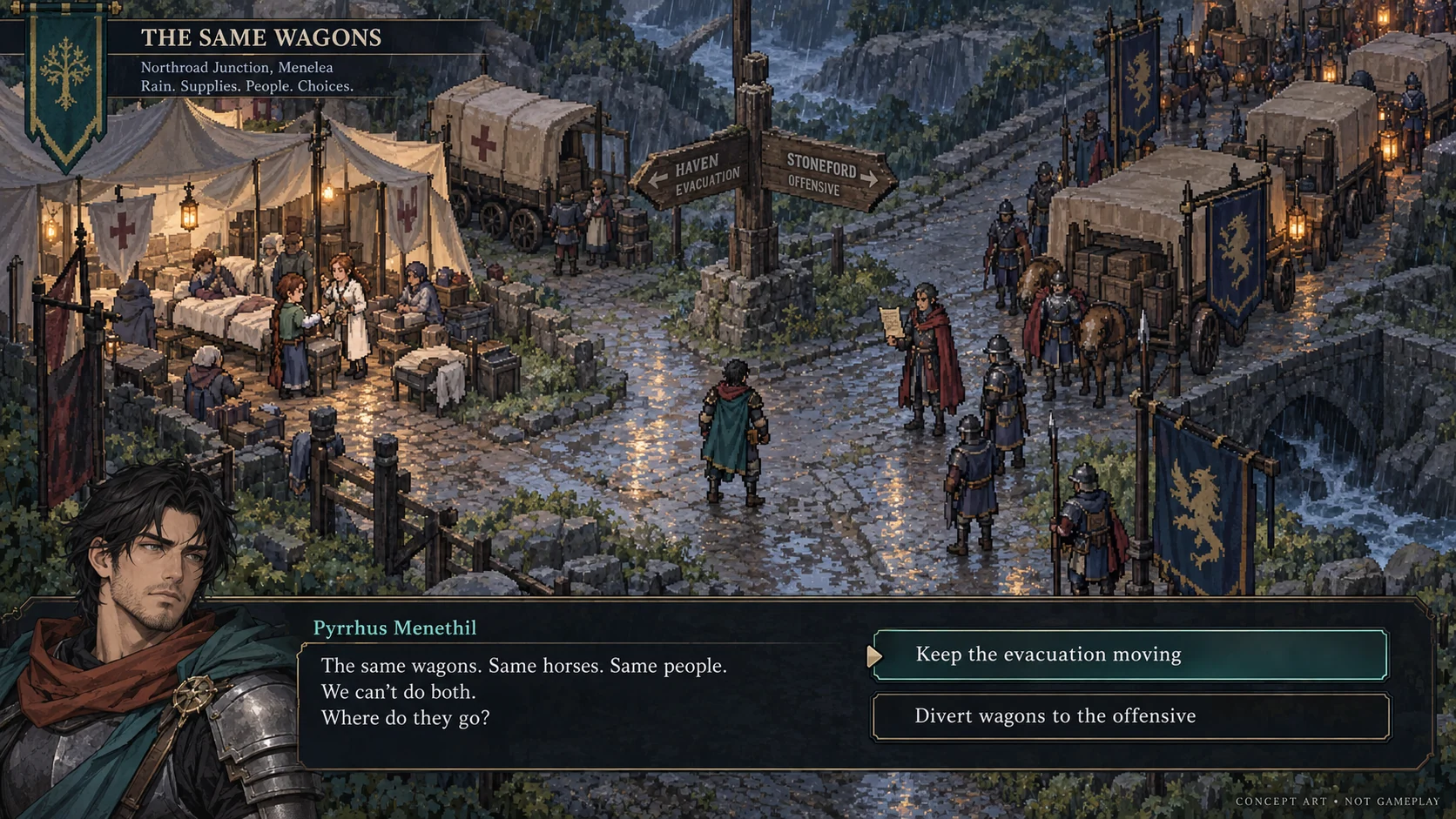
Working design. New events, appearances, mechanics, and political details remain proposals. See canon ledger.
Xeno accompanies a relief convoy through settlements where his image appears on royal collection notices. Some residents bow automatically. Others turn away. At a ruined school, a teacher asks him to read the decree that requisitioned their seed. He recognizes language from a speech he delivered. Nobody needs to accuse him theatrically. The discomfort of hearing his own promises aloud is enough.
His first attempt to help is to give away the company's reserve coin. Mira stops him because the reserve pays the wagon drivers and buys medicine at the next town. Xeno is furious at being corrected in public, then ashamed of the fury. He has to learn that generosity without accounting can simply move harm to people he cannot see. Later, he volunteers to keep the ration ledger and becomes unexpectedly good at patient, repetitive administration.
The chapter's mission protects hospital wagons during an attack on a junction. The player must decide whether to divert an escort from a strategically important convoy. Strong provincial preparation may allow both groups to survive with losses; poor preparation makes the tradeoff harsher. Xeno asks to remain with the wounded. Pyrrhus can permit a bounded responsibility rather than either indulging him recklessly or recreating the palace's confinement.
By the end, Xeno no longer asks only what a good king would do. He asks why a village's survival should depend on whether its king happens to be good. This does not instantly make him a republican philosopher. It gives him a concrete political goal: institutions that can stop a ruler from quietly doing what their father has done.
Source document: 06-expanded-storyline.md